Publications
First-author
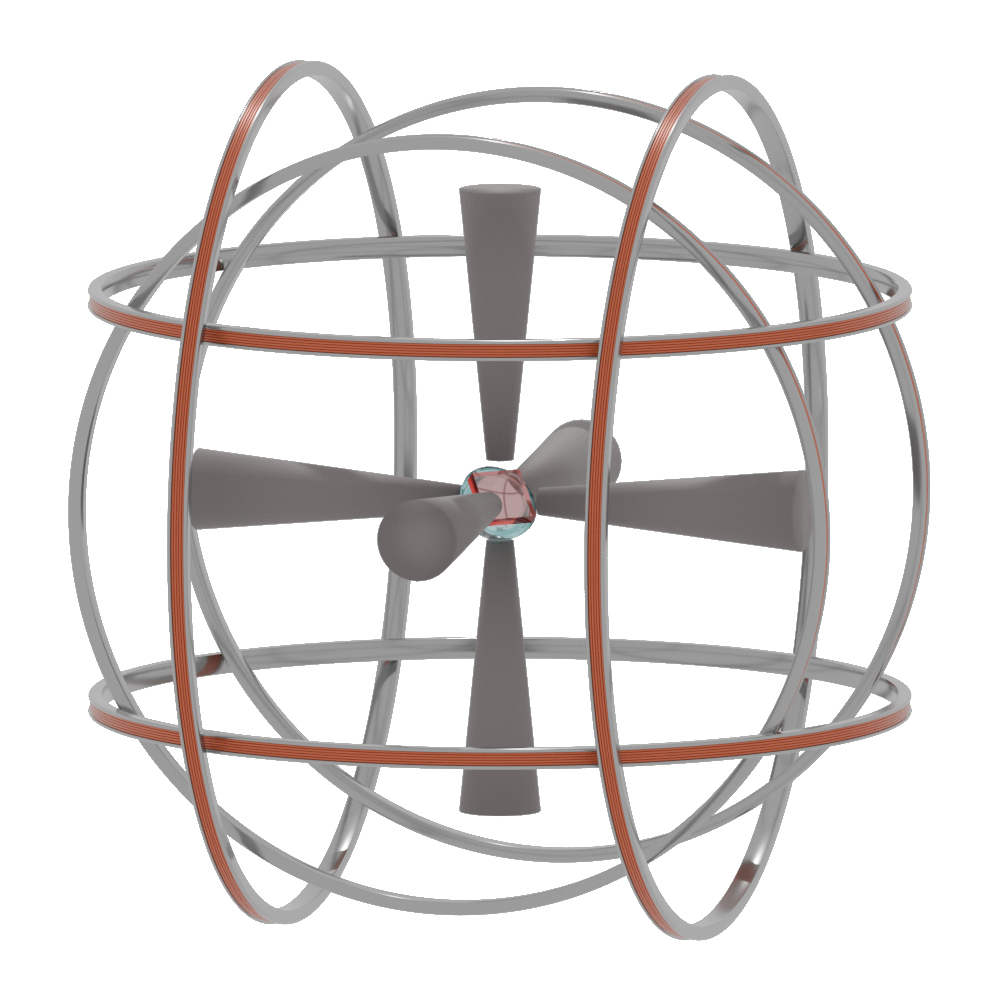
Earth’s field diamond vector magnetometry with isotropic magnetic flux concentrators
Six ferrite cones (shown enlarged) are carefully assembled to amplify the surrounding magnetic field onto a central .25x.25x.05 mm diamond (red) whose fluorescence contains vector magnetic field information, thanks to implanted Nitrogen Vacancy centers. A mold assembly housing (not pictured) fixes three of the cones while allowing the opposing three to move axially with a hand-controlled threading mechanism. The aim is to adjust parameters - diamond, gluing of the assembly, and eventually axial (and non-axial) cone placement - to minimize enhancement anisotropy. I.e., so that a magnetic field in any direction is magnified around 19 times, regardless of direction, with minimal change in direction. To this end, a three-axis helmholtz coil (loops of wire) is controlled with a power supply to send arbitrarily oriented magnetic fields of earth's magnitude in an automated manner, allowing quick measurement of magnetic fields in all directions with 10-degree resolution.
One challenge is the fitting of the 24-peak ODMR spectra containing vector magnetic field information and involving up to 72 parameters. Another challenge is that the cones, which are .24 mm at the tip, are not visible in the assembly, so that their positions need to be deduced (then optimized) from the anisotropy profile. The fitting problem is attacked with a clever Hamiltonian-constrained fit with guesses taking into account the anisotropy profile as predicted by just 6 measurements, since it was found that the anisotropy behaved like a matrix, transforming the magnetic field preferentially along one axis in three-dimensional space. The latter insight allowed quick axial tuning of the cones, whose positions were estimated by using python to control COMSOL simulations of the cones through machine learning and gradient descent algorithms which reasonably varied cone and diamond geometry.
The experiment involved in-depth analysis of 53 fit parameters, with one parameter unexpectedly revealing the room's temperature control swings! With some refinement, the fitting algorithm could fit all 1296 spectra with the magnetic field in all directions within an hour. This facilitated the minimization of anisotropy to <1% (<.2% with precalibration), and the system was found to have low deadzones across the solid angle. This represents the first attempt at three dimensional flux concentration to the extent known.